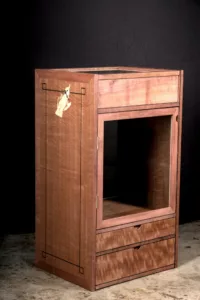
Marquetry and Parquetry
This is where I’m happiest — hunched over a cutting mat with stacks of veneer and a sharp knife, creating intricate patterns that will live on a piece of furniture for generations.
Marquetry and parquetry transform furniture from functional objects into works of art. Using contrasting wood veneers, I create visual elements ranging from delicate flowers and branches to bold geometric patterns that seem to flow across the surface.
What’s the Difference?
Both techniques involve applying thin veneers to a stable structural base to create decorative patterns, but they serve different purposes:
Marquetry creates pictorial images — flowers, birds, landscapes, or abstract designs. Each piece is carefully cut and assembled like a wooden puzzle to form a cohesive image.
Parquetry focuses on geometric patterns. Think flowing grain-shift designs, tessellations, or repeating motifs that create movement across a surface.
In my work, I often combine both — geometric structure meeting the asymmetry of nature.
The Process
My marquetry and parquetry pieces begin with inspiration from the natural world. I photograph shapes and patterns, then develop them into hand drawings. Each design goes through multiple revisions — leaf by leaf, flower by flower — until the image feels natural and artistically coherent.
I primarily use the 18th-century Italian packet method, which involves stacking multiple veneers together and cutting all design elements and the background simultaneously using a scroll saw. This ensures perfect fits between pieces.
The real magic happens in the details: individual veneer pieces are shaded with hot sand to create depth and shadow effects. Some veneers are selected for specific grain patterns that add movement or texture to a particular element. It’s finicky, time-consuming work — and I absolutely love it.
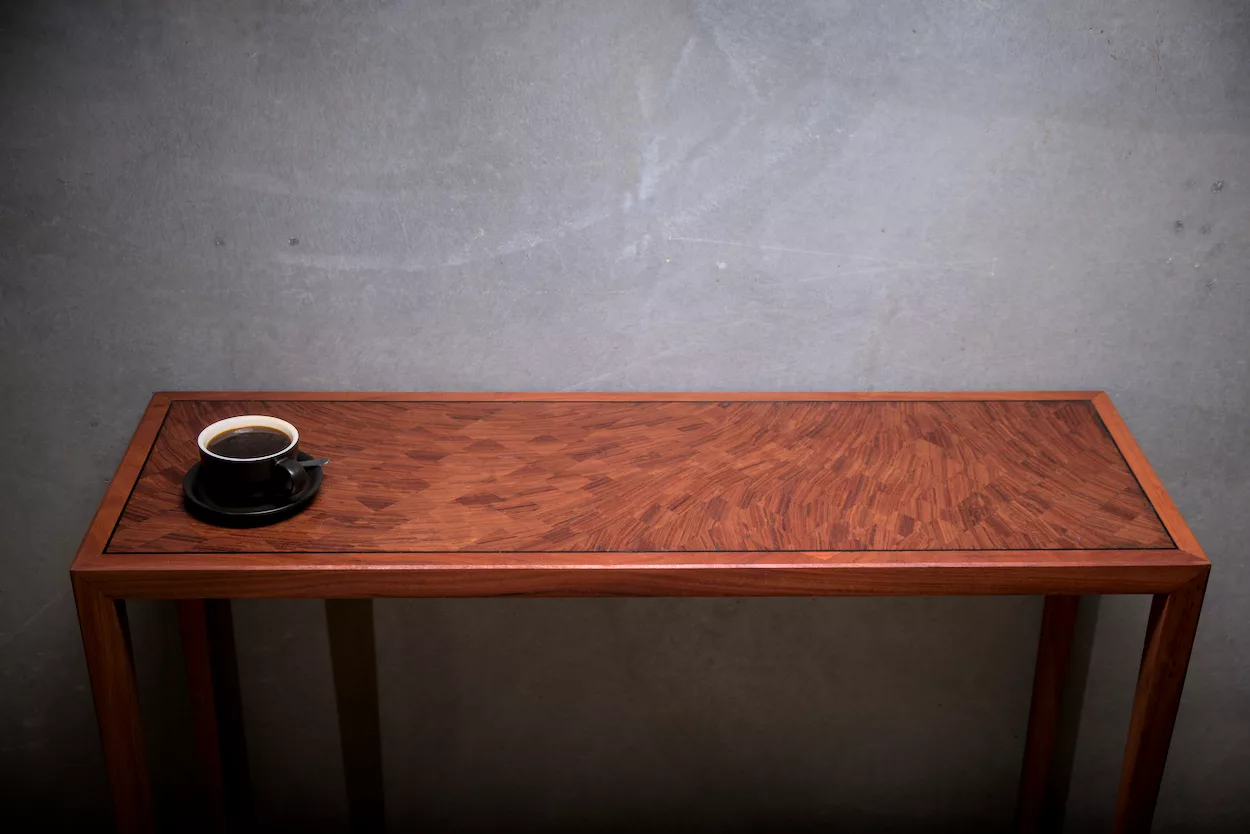
The finished veneer picture is then carefully adhered to the furniture base using a combination of traditional hide glue and modern adhesives — marrying old-world techniques with contemporary reliability.
Materials
While traditional marquetry can incorporate ivory, bone, mother-of-pearl, and brass, I work primarily with wood veneers. Australian timbers offer an incredible palette of colours and grain patterns — from the deep reds of Jarrah to the golden tones of Blackwood, the subtle greys of Tasmanian Myrtle to the rich browns of Walnut.
Each species brings its own character. Part of the art is knowing which timber will bring a particular element to life.
Custom Marquetry Commissions
Adding marquetry or parquetry to a commission does increase production time — each design is hand-drawn and hand-cut specifically for that piece. But it results in something truly unique: furniture that tells a story, that captures a moment in nature, that becomes a conversation piece and a future heirloom.
If you’re interested in commissioning a piece with marquetry or parquetry, I’d love to hear about your vision.