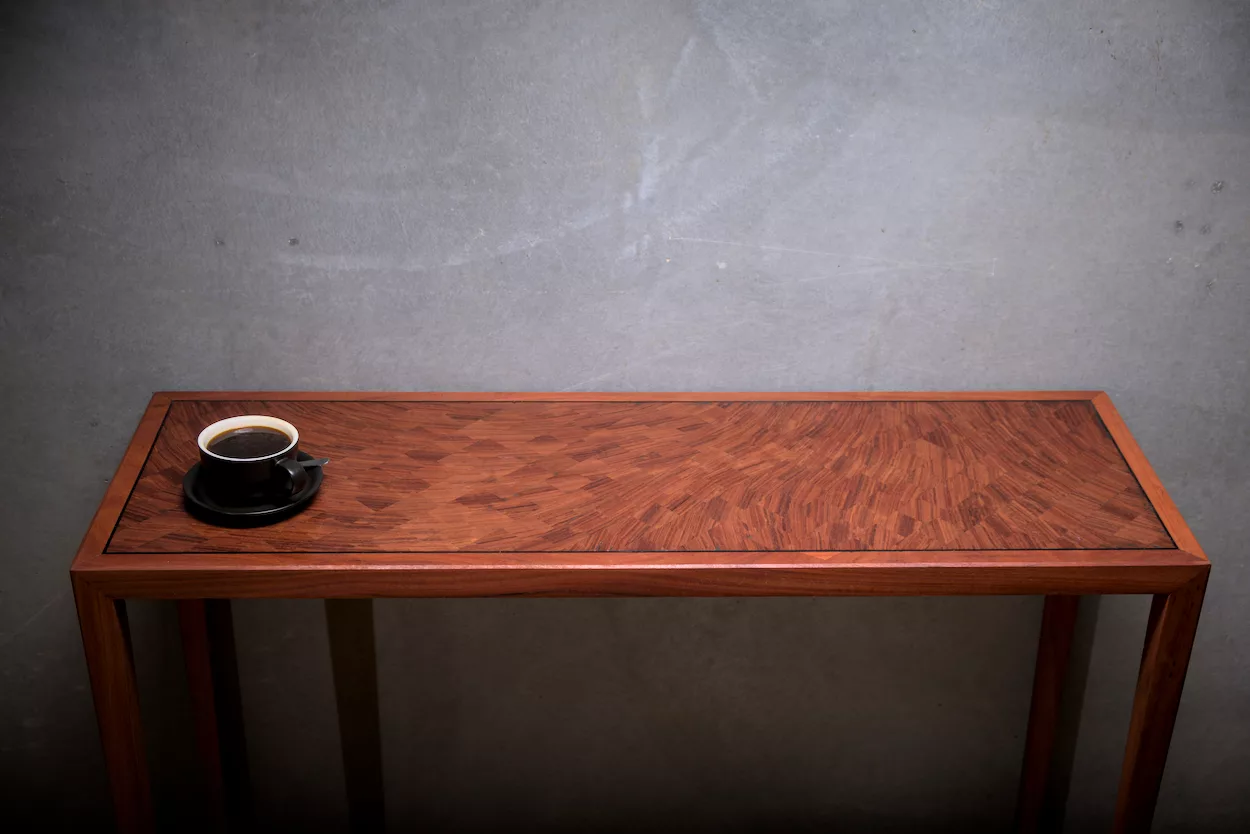
Hall Table in Red Gum with Parquetry Top and Rice Dumpling Joinery
Drawn in the air as much as it is built from timber.
A frame made from 40 mm solid Red Gum, joined at every corner with a rice dumpling joint — 粽角榫, zòngjiǎo sǔn — the three-way mitred corner joint developed by Ming dynasty furniture makers. Three components meet at a single point, their faces mitred to read as a single continuous line.
Inside, hidden tenons lock the joint in three axes without glue. On the surface, only three diagonal lines show where the wood meets. At 1600 mm long, 360 mm deep, and 800 mm high, the proportions are deliberately slender. The piece is drawn in the air as much as it is built from timber.
The top is where the work lives. Approximately 500 squares of Red Gum veneer, each rotated 5–10 degrees from its neighbour. The grain direction shifts incrementally across the surface, so the parquetry catches light in a sweeping pattern that moves as you walk past it. From a distance it reads as a single shimmering field. Up close, every square is its own small decision.
This frame is a design I return to. I’ve built four or five versions with different tops — Louis cubes, Victorian Blackwood with a Huon Pine stripe down the centre, and this, the most technically demanding of them. The parquetry version starts at $3,200; simpler tops from $1,800. Finished in blonde shellac.